The Yellowfin Tuna (Thunnus albacares)

When sunlight hits open water and turns it electric blue, that’s the domain of the Yellowfin Tuna — one of the ocean’s most elegant hunters. Sleek, relentless, and shaped entirely for speed, Thunnus albacares is the beating heart of warm currents across the globe. They are the ultimate pelagic athlete: muscle, instinct, and motion wrapped in gold and steel. Found throughout tropical and subtropical oceans, from the Pacific to the Atlantic, their presence marks abundance, temperature, and balance in motion.
Form and Function
Few fish are built with more efficiency than the Yellowfin Tuna. Their long, torpedo-shaped body is designed for one thing — velocity. The skin is smooth and scaleless across much of the body, coated in a fine mucus that reduces drag. The powerful sickle-shaped pectoral and dorsal fins fold flat into streamlined grooves when cruising, then flare outward when they turn or surge.
Their coloration is iconic — metallic blue across the back, silver-white below, and a vivid yellow along the finlets and tail that glows like molten sunlight. Beneath the surface, that flash of yellow acts as both camouflage and signal, breaking up their outline in shimmering water. When a Yellowfin streaks through a bait ball, it is both invisible and blinding all at once.
Eyes and Senses
Like all tuna, the Yellowfin lives in a world defined by speed and light. Their large eyes are tuned for sharp focus in bright pelagic waters, where light scatters and refracts endlessly. They can distinguish subtle contrasts — the flicker of a fleeing sardine or the angle of a scale catching the sun.
But their sensory systems go far beyond sight. Yellowfin have an incredibly developed lateral line — a pressure-sensitive network running along their flanks that allows them to “feel” turbulence, current, and motion. This system, paired with their acute hearing and water vibration sensitivity, gives them a sixth sense for locating prey. They detect not just movement but intent — the subtle acceleration of a baitfish about to dart.
Speed and Physiology
The Yellowfin’s physiology borders on miraculous. They are regional endotherms — capable of warming their blood above surrounding water temperature through a specialized vascular structure called the rete mirabile. This adaptation gives them enhanced muscle performance, faster neural response, and superior endurance. They can swim at sustained speeds that would exhaust most fish within minutes, maintaining body temperatures that keep their systems firing even in cooler thermoclines.
Every muscle fibre in a Yellowfin is oxygenated for efficiency. Their heart, proportionally massive, beats near constantly to deliver that fuel. Their gills extract oxygen from water with incredible precision, even during high-speed runs. They are one of the ocean’s few fish that never truly stop swimming — motion is life.
Feeding Behaviour and Surface Hunting
If Kingfish rule the reefs, Yellowfin command the open sea. They are social predators, often hunting in coordinated packs beneath schools of baitfish, herding them upward until the surface erupts in chaos.
These surface blitzes — or “boil-ups” — are among the most thrilling spectacles in marine life. Frigate birds wheel above, bait explodes in silver flashes, and the water churns white with energy. Yellowfin attack from below with precision and timing, their dorsal fins slicing the surface like blades.
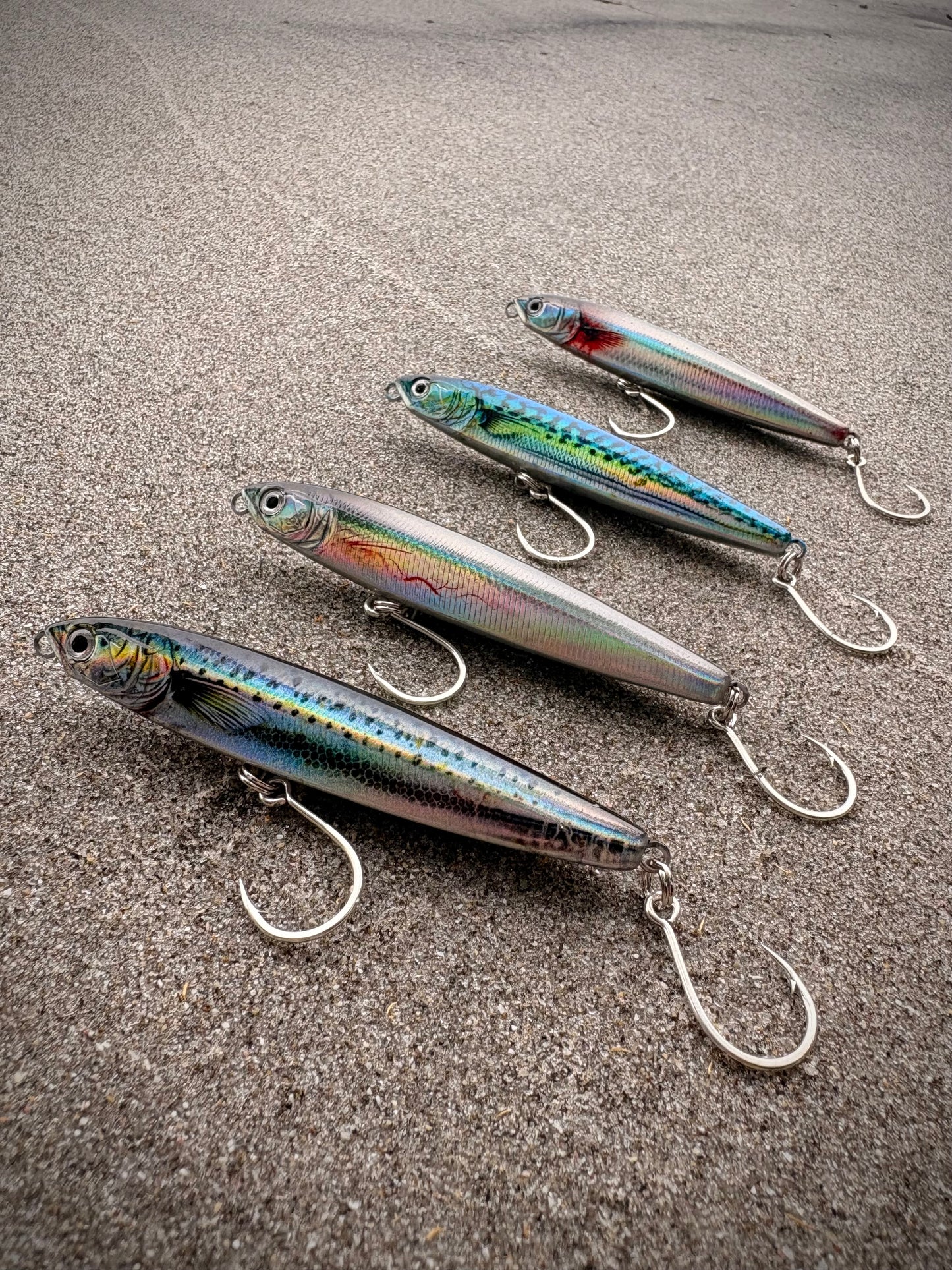
This behaviour makes them especially responsive to surface lures and stickbaits. A wounded, skipping bait on the surface perfectly mimics the chaos of a fleeing prey fish. To a Yellowfin, that commotion is an irresistible trigger — movement, vibration, and flash that cut through the noise of the ocean. It’s why lifelike, balanced lures find their mark where others go unnoticed.

Diet and Hunting Patterns
Yellowfin feed across layers of the water column, consuming anchovies, flying fish, mackerel, squid, and crustaceans. They often associate with dolphins and larger predators, exploiting their ability to corral bait. In tropical zones, they migrate with temperature bands and thermocline depth, following food and current rather than territory.
Juveniles form large schools, often mixing with skipjack tuna, while mature fish pair off or hunt in looser groups. Offshore anglers often find them near temperature breaks, seamounts, and current lines where nutrient-rich water fuels the food chain.
Growth and Longevity
Yellowfin are among the fastest-growing large fish on the planet. Within a year, they can reach 40–50 cm, and by age three they’re already capable of reproduction. Adults commonly weigh 40–80 kg, but true giants — exceeding 150 kg — are the stuff of ocean legend. Their lifespan is relatively short, rarely exceeding 8 years, but in that time they traverse entire ocean basins, guided by instinct, current, and the geometry of the sea.
Relatives and Range
Cousins to the Bigeye (Thunnus obesus) and the Bluefin (Thunnus thynnus), Yellowfin occupy a middle ground — smaller than the Bluefin, faster than the Bigeye, and more tropical than both. Their range extends from the Coral Sea to the eastern Pacific, across the Indian Ocean, and through equatorial currents where warm water and life collide. They are, in many ways, the perfect ocean nomad.
Respect the Target
To know the Yellowfin is to understand motion. They are never still — a pulse of the ocean that connects reefs, current lines, and continents. Every adaptation speaks of purpose: warm blood for endurance, fins for precision, and eyes for brilliance.
When you see them crash the surface in a flurry of foam, it’s not chaos — it’s a symphony. The ocean’s rhythm given form. And that’s the space OOSH lives in — the moment between movement and instinct, where lifelike becomes lethal.