The Mahi-Mahi (Coryphaena hippurus)

There are few sights in the ocean as dazzling as a Mahi-Mahi breaking the surface.
Like living lightning, they flash through bluewater in streaks of gold and emerald, a visual symphony of speed and instinct. In every sense, Coryphaena hippurus is a masterpiece of evolution — a predator built for light, motion, and momentary brilliance.
Form & Function
Mahi-Mahi are one of nature’s most striking designs. Their bodies are long, laterally compressed, and curved into a perfect arc that screams velocity. The head slopes steeply into a blunt, high forehead — especially in males, called bulls — while the dorsal fin runs almost the full length of the body, creating a continuous plane for lift and control.
Their coloration borders on the unbelievable: neon green-blue across the back, fading into golden flanks and silver beneath. When alive and charged with adrenaline, they shimmer like oil on water — colours shifting by the second, an iridescent language of dominance and excitement. It’s said that no camera ever truly captures a Mahi’s glow — it’s a living spectrum.
This brilliance isn’t just beauty. The scales are micro-reflective, confusing both predators and prey in open light. Their streamlined profile and lightweight skeleton allow for incredible acceleration; they can burst from 0 to 50 km/h in seconds.
Eyes and Senses
The Mahi-Mahi’s world is one of constant motion and flash. Its large eyes, positioned high on the head, give panoramic vision — ideal for scanning bait schools against the glare of the surface. Their retinas are rich in cones, giving exceptional colour perception, vital for identifying prey among the scatter of light and foam.
Their lateral line runs uninterrupted along the body, a sensitive radar tuned to vibration and displacement. It allows them to coordinate in pairs or small groups during high-speed chases, each fish reacting to the water pressure around the other — a synchronized dance of predation.
Mahi are also drawn to sound and surface disturbance. The thump of baitfish hitting the water or the commotion of flying fish skipping away is enough to pull them from the depths. It’s why surface lures, especially those that look alive, are so deadly.
Feeding and Behaviour
Mahi-Mahi are opportunistic hunters. They patrol temperature lines, floating debris, and weed mats where life gathers. There, they strike fast and decisively — small mackerel, flying fish, squid, and crustaceans make up much of their diet.
They’re often seen in pairs — a bull and a cow — or in small pods of half a dozen individuals hunting together. They attack from below, driving bait to the surface in a flurry of silver and foam. These surface hunts are pure theatre: sprays of water, flashes of colour, and the unmistakable gleam of gold slicing through chaos.
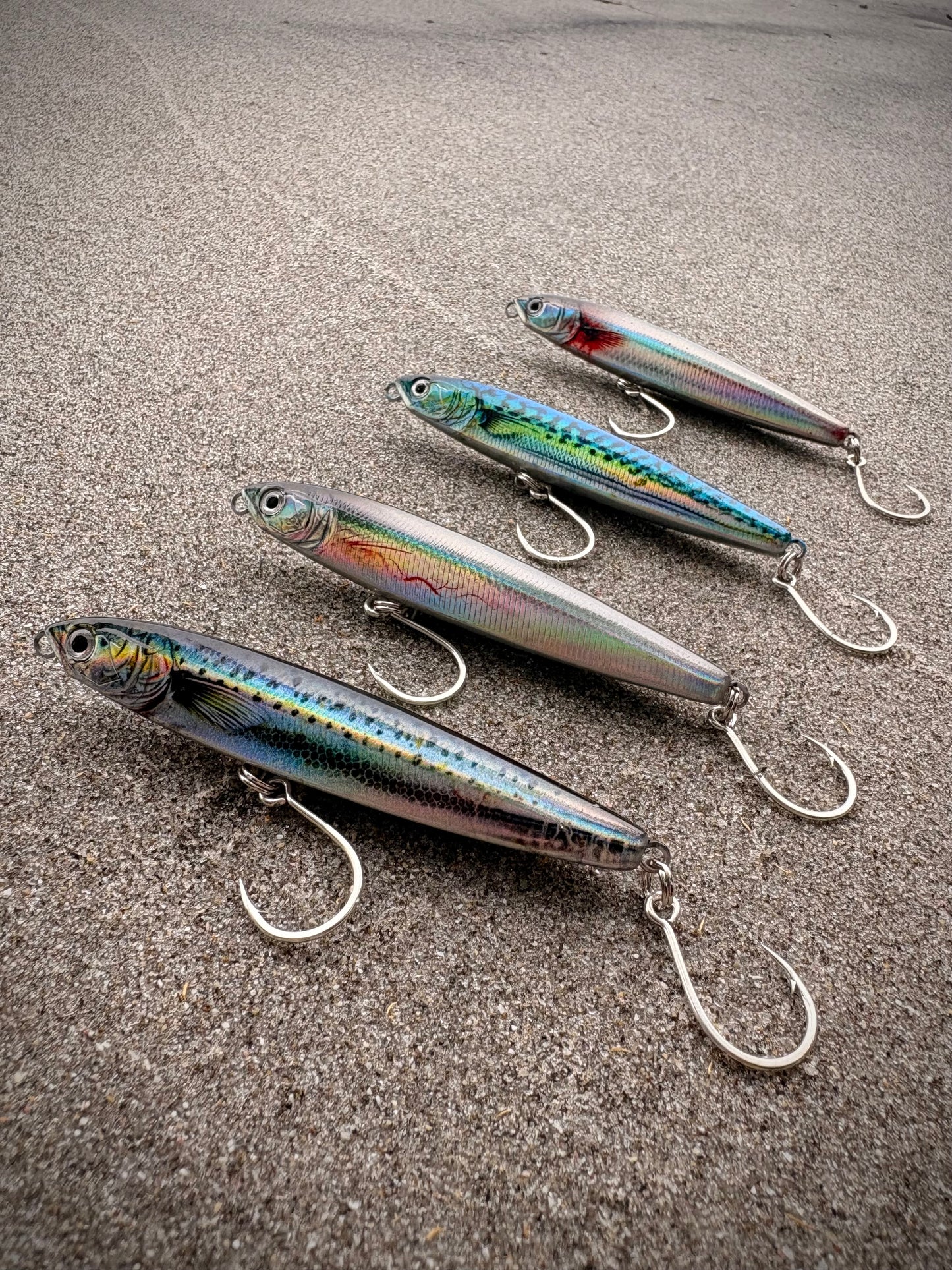
It’s this behaviour that makes them a perfect match for stickbaits and fast-moving surface lures. A well-tuned OOSH lure doesn’t just imitate a fish — it imitates the confusion of prey fleeing for its life. Mahi are wired to chase motion and flash, and when that combination is right, the strike is instantaneous.

Growth and Life Cycle
Few fish grow as explosively as Mahi-Mahi. They are the sprinters of the ocean — short-lived, fast-living. Within a year, they can exceed 1 metre in length; by two years, they’re mature and often already dominant.
Despite this speed of life, their lifespan is brief — rarely more than four to five years. But in that time, they cross oceans, spawning multiple times a year in warm waters above 20 °C. Their eggs drift in surface currents, hatching within days, feeding immediately on plankton until their predatory shape begins to take form.
This rapid cycle ensures abundance — Mahi populations replenish quickly, a perfect adaptation for a species built on speed and light.
Distribution and Environment
Mahi-Mahi inhabit tropical and subtropical waters worldwide — from the Caribbean to the Coral Sea, from Hawaii to northern New Zealand. They favour open water between 21–30 °C and are rarely far from the surface. They’re drawn to floating structure — weed lines, driftwood, even buoys — where smaller life congregates.
Their global presence has made them a universal symbol of offshore sportfishing, but beyond that, they are ecological indicators — proof of a healthy pelagic ecosystem.
Respect the Target
The Mahi-Mahi lives fast, burns bright, and fades quickly. Every moment of its life is acceleration — colour, current, and heat. It is proof that beauty and function can coexist without compromise.
To see one light up beside the boat is to witness pure energy made flesh. To catch one is to connect, briefly, with the wild pulse of the tropics.
They remind us that the ocean’s true artistry isn’t in stillness — it’s in movement, light, and instinct.