The Giant Trevally (Caranx ignobilis)

There are predators — and then there is the Giant Trevally.
To divers, it’s a presence felt before it’s seen.
To anglers, it’s the thud in the rod that feels like electricity.
To the reef, it’s balance and fear combined.
Form & Function
Everything about a GT’s design speaks of brute efficiency. A broad, deep body built for sudden torque, shoulders like an anvil, and eyes set wide to track movement from every angle. The dorsal line arches high before dropping into a muscular caudal peduncle that powers a scythe-shaped tail — the lever that drives its signature burst.
The scales are thick, armour-like, sometimes marked by scars from coral or rival jaws. Mature males darken to near black when dominant, a warning display of territorial control. Their lateral compression gives them both turning power and the ability to knife through turbulent whitewater without losing lift.
Eyes and Senses
The Giant Trevally’s sensory array is extraordinary. Its eyes are large, with an abundance of cone and rod cells that give clear vision from the surface glare to the dim blue of the reef slope. They read light contrast rather than colour — perfect for isolating silhouettes of prey against the shimmer of current.
Along the body runs a highly sensitive lateral line that detects micro-vibrations — the flick of a mullet’s tail, the uneven rhythm of a wounded fusilier. In the chaos of surf and foam, when visibility drops to nothing, the GT hunts by feel and pressure. Its hearing is tuned to the low-frequency resonance of moving water; it knows the sound of panic long before the eye confirms it.
Behaviour and Intelligence
Few fish exhibit deliberate behaviour like the Giant Trevally. They patrol with intent, not randomness. On falling tides they stage near passes and reef corners, using eddies to their advantage. They learn the timing of bait movements and will even exploit human patterns — shadowing boats or following divers to flush prey.
They are capable of cooperative hunting. Pairs and small groups will flank a bait school, one driving it into the shallows while another strikes from the side. They also hunt alone, preferring ambush over pursuit — a single devastating acceleration that ends in impact rather than chase.
Their intelligence borders on problem-solving: field studies have shown GTs ambushing fledgling terns from below, breaching the surface to snatch birds mid-flight. It’s apex awareness — not random aggression.
Feeding and Environment
The GT’s domain is the reef edge and the surf line. They favour warm tropical water between 24 – 30 °C, where current and structure meet. From the flats of the Seychelles to the volcanic ledges of Vanuatu, they thrive wherever bait funnels through constriction points.
Their diet is broad — mullet, fusiliers, squid, flying fish, crustaceans, even small reef fish. They feed most actively during tidal movement, when sound and current conceal them. A GT strike is rarely a flurry of bites; it’s a single, violent surge that engulfs the prey whole.
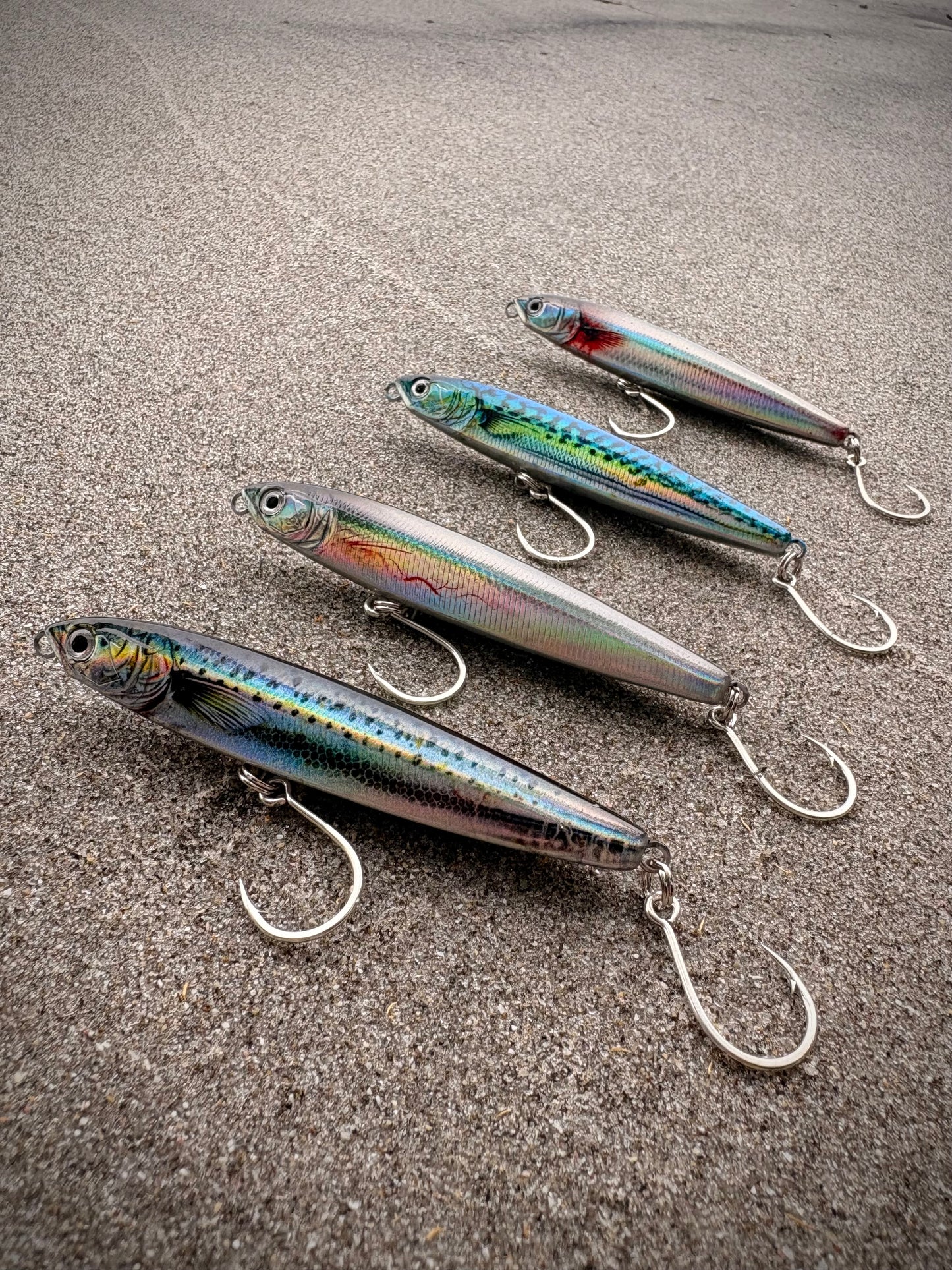
At the surface, their attacks are spectacular — explosions of spray and whitewater as they hit fleeing bait. This is where OOSH stickbaits live — that moment of predatory clarity when the fish commits to violence. A properly balanced surface lure mimics not just the movement, but the energy signature of wounded prey; to a GT, that vibration is irresistible.

Growth and Power
Giant Trevally are slow to mature but grow colossal. Juveniles of 20 cm ride estuarine currents; adults exceeding 60 kg dominate reef systems. Some individuals are estimated to reach 80 kg, though these are rare elders — perhaps thirty years old. Their lifespan gives them memory; each big fish is an apex survivor with decades of hunting encoded in muscle.
Their muscle fibre composition favours short, explosive anaerobic bursts. The result is that violent first run that can buckle a rod or snap line against coral. They are built for ambush, not endurance — though their lungs of the sea can sustain repeated charges when adrenaline floods their system.
Distribution and Relatives
Caranx ignobilis is the largest of the jack family, spread through the Indo-Pacific from East Africa to Hawaii. Each region has its legends — the “Ulua” of Polynesia, the “Giant Kingfish” of Australia — but all are the same creature, forged by reef current and pressure.
They share lineage with species like the Bluefin Trevally and Bigeye Trevally, yet none reach the same bulk or dominance. Where others school, the GT rules.
Respect the Target
To understand a Giant Trevally is to respect it utterly. It is the embodiment of aggression refined by evolution — no wasted motion, no hesitation, only purpose. When it commits to the surface, the strike is not instinct; it’s decision.
They are more than trophies. They are proof that perfection in nature is measured by function, not form.
When a GT takes your lure, it’s not a fish you’re connected to — it’s the reef itself, striking back.