The Yellowtail Kingfish (Seriola lalandi)
 Kingfish don’t chase because they’re angry.
They chase because they’re built to.
If snapper are decision-makers, kingfish are executioners. Everything about them — from muscle fibre to eye placement — is tuned for pursuit. Not opportunistic feeding. Not grazing. Pursuit.
To understand kingfish, you have to stop thinking about them as reef fish that swim fast.
They are pelagic athletes that tolerate reefs.
FORM AND FUNCTION — BUILT FOR OXYGEN
A kingfish’s body is not just streamlined, it is pressure-tested by evolution for sustained speed.
That torpedo shape isn’t aesthetic. It reduces drag at high velocity. The narrow caudal peduncle acts like a hinge, transferring energy from the body into the sickle-shaped tail with brutal efficiency. When that tail moves, it doesn’t flick. It drives.
Unlike ambush predators that rely heavily on white muscle for short bursts, kingfish are rich in red muscle, oxygenated, endurance-driven tissue that allows repeated acceleration without fatigue. This is why they don’t just hit once. They circle. They track. They test. Then they commit.
And it’s why they love current.
Strong, clean, oxygen-rich water isn’t just comfortable for a kingfish, it’s fuel. Headlands, reef points, tide lines, whitewater wash zones, these aren’t random locations. They are natural conveyor belts delivering both bait and oxygen.
Where the water moves, kingfish thrive.

SPEED, FORCE, AND POWER
Large kingfish have been recorded reaching burst speeds exceeding 50 km/h.
But speed alone isn’t what breaks anglers.
Torque does.
That thick shoulder region, the part anglers call “the engine room” houses enormous muscle density relative to body size. Combine that with a rigid body and high tail beat frequency, and you get a fish capable of generating immense lateral force in a split second.
This is why kingfish don’t just run.
They angle.
They use reef.
They use current.
They use structure.
That first dive toward cover isn’t panic. It’s instinct refined over millions of years: neutralise the threat by increasing resistance.
The fight is not chaos.
It’s design.
EYES, VIBRATION, AND DECISION-MAKING
Kingfish are visual predators with forward-biased eye placement, giving them excellent depth perception when tracking prey. They are particularly sensitive to contrast and silhouette against bright water, injured baitfish don’t glow, they interrupt light.
But sight is only one layer.
Their lateral line system allows them to detect micro-vibrations in current. A struggling bait doesn’t just look wrong, it feels wrong. Subtle irregularity is often more powerful than flash.
This is why kingfish will sometimes ignore perfect symmetry… yet crush something slightly off.
They aren’t reckless feeders.
They are energy economists.
Every strike is a calculation:
Distance.
Escape angle.
Current advantage.
Energy return.
When the equation makes sense, they don’t hesitate.

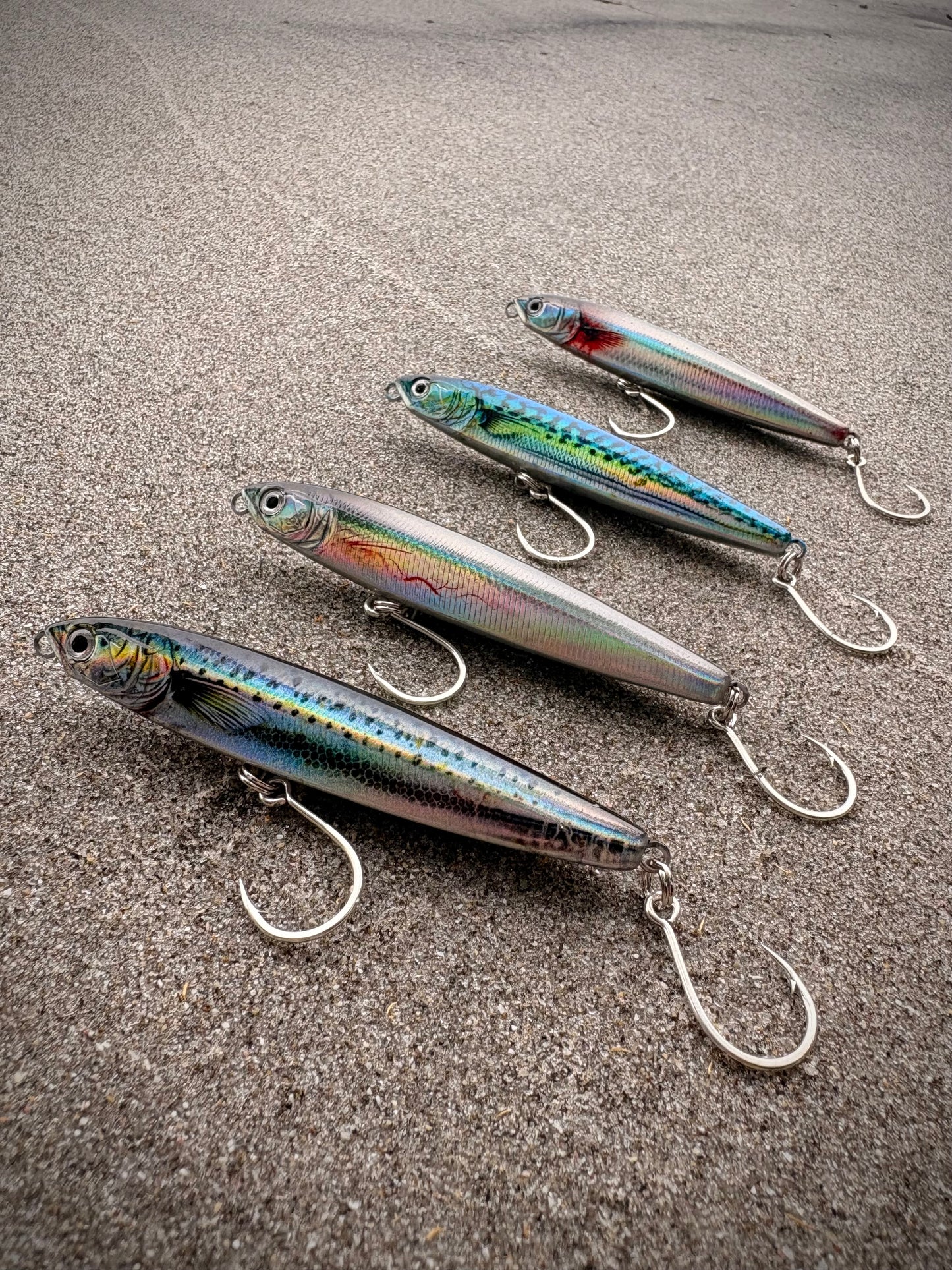
The OOSH “Bleeding Mullet” is built around a simple truth: kingfish don’t chase perfection — they commit to prey that looks compromised. Subtle irregularity triggers instinct faster than flash ever could.
GROUP BEHAVIOUR — CONTROLLED COMPETITION
Juvenile kingfish school tightly for protection. Adults operate differently.
Mature fish often move in loose visual contact, not packed, but aware. This spacing allows for rapid directional changes during coordinated attacks. When bait is pressured against structure or pushed to the surface, kingfish may work cooperatively without appearing to.
This explains something anglers know well:
Hook one, and others often appear.
It isn’t coincidence.
Competition sharpens aggression. A committed strike from one fish can trigger immediate reaction from another nearby.
They are opportunists, but also opportunists aware of each other.
DIET AND HUNTING STRATEGY
Juveniles feed on krill and small crustaceans, but adult kingfish are serious hunters. Their diet includes pilchards, mackerel, squid, kahawai, trevally, and even small reef fish.
They are capable of:
- Ambush from below
- Mid-water pursuit
- Surface eruptions
- Reef-edge intercepts
But one pattern repeats across regions:
They isolate weakness.
In workups, kingfish often position below bait schools, waiting for injured or disoriented fish to drop. Along reef edges, they patrol current lines, allowing prey to drift into their strike zone. Around headlands, they use turbulence as cover.
They don’t need the fastest bait in the school.
They want the easiest.

GROWTH, SIZE, AND LONGEVITY
Kingfish grow quickly in their early years, often reaching 60 cm within twelve months under favourable conditions. Sexual maturity typically occurs between three and five years.
Large adults regularly exceed 1.2 metres and 20 kilograms in New Zealand waters. Fish over 40 kilograms are rare but documented. Otolith ageing studies suggest individuals may live 20 years or more in temperate regions.
Growth rate varies significantly with water temperature and food availability. Warmer climates accelerate growth but can shorten lifespan.
Large kingfish represent survival.
They are not common by accident.
INTELLIGENCE AND ADAPTABILITY
Divers frequently report kingfish circling, observing, and testing unfamiliar objects. They learn. They associate boat noise, structure, and seasonal patterns with feeding opportunity.
They are equally at home shadowing dolphin pods offshore or working the wash in knee-deep whitewater.
They adjust.
This adaptability is one reason they remain such a compelling target. They are not predictable in the way bottom-dwelling fish can be. They shift behaviour with tide, temperature, light, and pressure.
Sometimes they are explosive.
Sometimes they are cautious.
Understanding that range is the difference between casting at fish — and hunting them.
RESPECT THE TARGET
Kingfish are not simply strong fish.
They are oxygen-driven, current-loving, high-efficiency predators shaped entirely by motion. Every muscle fibre, every sensory organ, every instinct serves the same purpose: pursuit with precision.
When that flash of gold appears beneath a swell, you are not seeing aggression.
You are seeing design.
To know kingfish is to understand energy, momentum, and vulnerability.
They don’t chase because they’re angry.
They chase because they can.
Know your target.
Respect your target.
OOSH.
Download the wallpaper below and keep this predator close....