FLYING FISH - The prey behind the predator.

UNDERSTANDING THE PREY BEHIND THE PREDATOR
Know Your Target doesn’t stop at the fish you’re trying to catch. To understand a predator, sometimes you need to understand what it’s looking for when it’s hungry.
As the water begins to warm and yellowfin season starts creeping onto the radar for anglers across Australia and New Zealand, most of us naturally begin thinking about the target.
Where will the tuna turn up?
What water temperature should we be looking for?
Where are the current lines?
What are the birds doing?
What should we troll?
All good questions.
But there is another question worth asking.
What are the tuna looking for?
Because it isn’t only important to understand your prey.
It’s important to understand your prey’s prey.
And few baitfish have a more interesting relationship with the pelagic predators hunting them than the flying fish.
A FISH THAT LEARNED TO LEAVE THE OCEAN
Flying fish belong to the family Exocoetidae, a group found throughout tropical and subtropical oceans around the world.
They’re unmistakable.
A streamlined body built for speed. An exaggerated lower lobe on the tail. Huge pectoral fins that fold against the body underwater and spread into something resembling wings once the fish breaks the surface.
But despite the name, there is an important point to understand about flying fish.
They spend most of their lives swimming.
Flying isn’t their normal means of getting around the ocean.
It’s an escape strategy.
When threatened by tuna, mahi-mahi, billfish, wahoo and other pelagic predators, a flying fish can accelerate rapidly towards the surface, break through it and spread those enormous pectoral fins.
It doesn’t truly fly in the way a bird does.
It glides.
The fish generates its speed underwater. Its streamlined body punches through the surface and its enlarged fins then turn that speed into an airborne escape.
And that distinction becomes very important when we start thinking like anglers.
Because we tend to picture a flying fish above the water.
A tuna spends considerably more time encountering one below it.
BUILT FOR ESCAPE

Everything about a flying fish makes a little more sense when you consider the neighbourhood it lives in.
The open ocean isn’t exactly a forgiving place to be a small fish.
Flying fish occupy an important middle position in tropical and subtropical pelagic food webs. They feed on smaller organisms, while in turn providing food for some of the ocean’s fastest and most formidable predators.
Scientific research describes flying fish as an important mid-trophic component of these ecosystems — essentially a biological link between tiny planktonic life and the large predators we love chasing.
Their escape mechanism is extraordinary.
Flying fish accelerate underwater before breaking the surface. Research into their biomechanics suggests that the explosive swimming performance required for take-off becomes difficult in water below roughly 20°C.
Once airborne, those oversized pectoral fins become gliding surfaces.
The longer lower lobe of the tail is another clever adaptation. Flying fish can use it at the surface to generate additional propulsion before becoming completely airborne, and in some circumstances can regain speed as they continue their escape.
Imagine being a tuna for a moment.
Your meal hasn’t simply changed direction.
It has left the ocean.
WARM WATER, FLYING FISH AND WHAT TO LOOK FOR
Flying fish are fundamentally creatures of warmer water.
They’re distributed throughout tropical and subtropical oceans, and research looking at thousands of flying fish across the eastern tropical Pacific found sea-surface temperature to be one of the strongest predictors of their habitat and distribution.
That doesn’t mean there is one magic temperature at which flying fish suddenly appear.
Different species occupy different habitats, and temperature interacts with currents, food availability, salinity, productivity and oceanographic features.
But there is a useful takeaway for anglers.
Think warm water.
Think blue water.
Think current.
Think areas where oceanic water and food are being concentrated.
For Australian anglers, particularly along the east coast, that environment can be heavily influenced by the warm waters of the East Australian Current as it moves south along the coastline. Flying fish form part of an offshore ecosystem shared with some of the predators we’re most interested in — including yellowfin tuna, mahi-mahi, wahoo and billfish.
Across the Tasman, New Zealand anglers see another side of that same warm-water story. As warmer oceanic water pushes into northern New Zealand through summer, pelagic species that we associate with more tropical environments become increasingly relevant.
Historical New Zealand fisheries information records yellowfin regularly appearing during summer in warmer waters off the northeast coast of the North Island, with limited historical data putting an optimum fishing temperature range around 19–22°C.
For anglers on both sides of the Tasman, the important thing isn’t to treat a particular number on the temperature gauge as a switch.
It’s to understand what that temperature represents.
Warm water moving into an area can bring an entire ecosystem with it.
Plankton.
Baitfish.
Flying fish.
And eventually, the predators following them.
The temperature is a clue. The life in that water is what we’re really looking for.
WHAT DOES A FLYING FISH EAT?

This is where Knowing Your Target gets interesting.
If we want to understand the predator, we study its prey.
If we want to understand where that prey might be, sometimes we need to go another level down.
What is the flying fish looking for?
Flying fish feed heavily within the planktonic food web, taking zooplankton and other small organisms available near the surface.
That makes them part of a much bigger chain.
Oceanographic conditions influence plankton and productivity.
Currents, eddies and fronts can concentrate food.
Food attracts smaller pelagic life.
Flying fish exploit that food.
Predators exploit the flying fish.
And eventually an angler sees a frigate bird, a patch of nervous water or several flying fish suddenly erupting beside the boat and thinks:
There’s something going on here.
That’s the point.
Don’t necessarily look at a flying fish as an isolated observation.
Look at it as a clue.
WHEN ARE YOU LIKELY TO SEE THEM?

For many anglers, the first sign of flying fish isn’t actually something they deliberately find.
It’s something the boat disturbs.
You’re travelling through warm offshore water and suddenly a fish rockets from beside the hull, spreads its fins and sails away across the surface.
Then another goes.
Then five.
That’s when it’s worth paying attention.
Flying fish generally occupy the upper layers of the open ocean, which makes them particularly visible when a boat, predator or other disturbance causes them to launch.
Seeing one flying fish is cool.
Seeing repeated groups of flying fish is information.
Take notice of the water you’re in.
Temperature.
Colour.
Current.
Bird activity.
Other bait.
Any visible current lines, temperature breaks, debris or structure.
And perhaps most importantly, watch what happens behind the flyers.
Because sometimes the reason they’re flying isn’t your boat.
THE YELLOWFIN CONNECTION
Yellowfin tuna are incredibly capable predators, but they’re also opportunistic feeders.
Studies of tuna feeding behaviour show that yellowfin consume a wide variety of fish, crustaceans and squid depending on what’s available in the area.
Flying fish sit squarely inside that pelagic menu.
And when you think about how the two animals are built, it’s easy to understand why the interaction can be spectacular.
A yellowfin is fast.
A flying fish has evolved an escape mechanism specifically designed to deal with fast predators.
The tuna pushes.
The flying fish accelerates.
The flying fish reaches the surface.
And eventually it has to come back down.
That’s the problem with having wings when you’re still a fish.
Sooner or later, you have to return to the ocean.
For an angler, flying fish being repeatedly pushed from the water can therefore be a serious piece of information.
You may not have seen a yellowfin.
You may not have marked one yet.
But something has caused that bait to behave differently.
And understanding the bait can sometimes tell you about the predator before the predator shows itself.
PERHAPS THE MOST CONVINCING FLYING FISH LURE ISN’T A LURE AT ALL

There is a fishing technique used in several parts of the world that beautifully demonstrates just how powerful the flying-fish/predator relationship can be.
Kite fishing with a rigged flying fish.
The technique has become particularly famous in fisheries such as Southern California and Baja, where rigged flying fish are used to target large tuna.
Rather than simply towing the bait behind the boat in the conventional way, the fishing line is controlled using a kite.
A real flying fish is rigged — often with its large pectoral fins held open — and presented at or immediately above the surface.
Depending on the exact technique and conditions, the bait can be made to touch down, skip, splash, lift from the water and return again.
Think about what that looks like from below.
A flying fish desperately trying to escape.
It breaks the surface.
Skips.
Glides.
Touches down.
And tries to leave again.
There are accounts of tuna refusing more conventional presentations before attacking a flying fish presented from a kite.
That’s not magic.
It’s behaviour.
The presentation isn’t merely copying the colour of the prey.
It is attempting to copy the event the predator associates with vulnerable prey.
And that’s something lure anglers should think about.
BUT HERE’S THE PART WE FIND REALLY INTERESTING…
Kite fishing understandably focuses on the most spectacular moment in the life of a flying fish.
The escape.
But remember what we established earlier.
Despite their name, flying fish spend most of their lives under the water.
Swimming.
Feeding.
Moving through the upper layers of the ocean.
Long before one explodes through the surface with a yellowfin behind it, that flying fish was simply another baitfish swimming in the water column.
And that raises an interesting question.
If we’re trying to imitate a flying fish, should we only imitate the few seconds it spends above the water?
Or should we also think about the animal a tuna spends considerably more time hunting beneath it?
That’s a question we’ve been asking ourselves lately.
WHAT DOES ALL THIS MEAN FOR THE ANGLER?

Understanding flying fish doesn’t mean throwing away everything in the tackle box and only fishing blue-and-silver lures.
It means adding another layer to how you read the ocean.
Warm offshore water matters.
Flying fish activity matters.
Bird behaviour matters.
Current lines and temperature changes matter.
The presence of repeated groups of flying fish matters.
And the behaviour of that bait may matter even more than simply seeing it.
If flying fish are calmly present in an area, you’ve found part of the food web.
If they’re suddenly leaving the ocean at speed, something may be actively interacting with that food web.
There is also a lesson in lure presentation.
Sometimes matching the hatch is about size.
Sometimes it’s colour.
Sometimes it’s profile.
And sometimes it’s behaviour.
The best imitation isn’t necessarily the lure that looks most like a baitfish sitting motionless in your hand.
It’s the one that represents what the predator expects that baitfish to do.
ONE LAST THOUGHT…
Every OOSH lure starts in roughly the same place.
Not with a shape.
Not with a colour chart.
Not with a catalogue.
With the real thing.
How does it swim?
Where does it live?
What does it eat?
What eats it?
And what does it do when something is trying very hard to kill it?
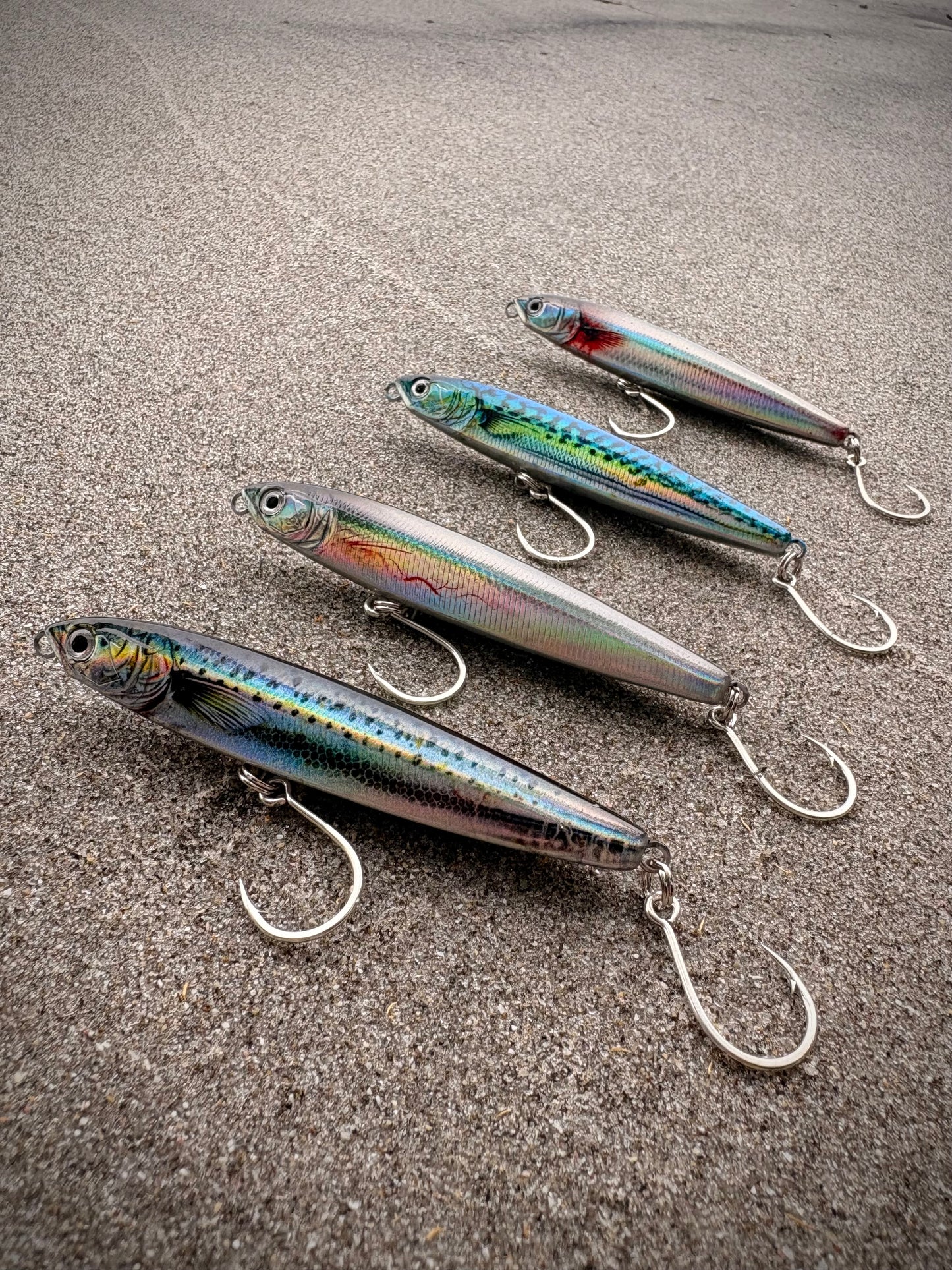
The more we’ve studied flying fish — how they swim, how they escape, where they’re found and how predators hunt them — the more we’ve wondered whether one of the ocean’s most recognisable baitfish is properly represented in the lures we fish.
Particularly when you remember one simple fact.
A flying fish spends most of its life underwater.
Perhaps a flying fish imitation shouldn’t only represent the few seconds a flying fish spends above the surface.
Maybe it should represent the animal a yellowfin spends far more time hunting beneath it.
That question has led to something new on the OOSH development bench.
We’re not quite done yet.
But we can give you a name.
OMA.

Keen to follow along with OMA’s development? Join our subscriber list and we will share how it’s progressing.
OOSH.
Know Your Target.
Because understanding your target doesn’t stop with the fish you’re trying to catch.
To understand a predator, sometimes you need to understand what it’s looking for when it’s hungry.
LIFELIKE + LETHAL.