DUSKY FLATHEAD (Platycephalus fuscus) THE AMBUSH PREDATOR HIDING IN PLAIN SIGHT

DUSKY FLATHEAD
THE AMBUSH PREDATOR HIDING IN PLAIN SIGHT
Some predators chase their food. Others have evolved so they barely need to.
For Australian anglers, the flathead needs very little introduction.
They're accessible.
They're widespread.
They live in places you can reach from a boat, kayak or sometimes simply by walking off the bank.
And they have an extraordinary ability to disappear into a piece of bottom that looks completely empty.
For New Zealand anglers, they're something slightly stranger.
We simply don't have them.
Which seems almost unfair when you look at places like Tauranga Harbour, with kilometres of shallow flats, channels, sand, mud, seagrass and moving bait.
Look at habitat like that through Australian eyes and it's difficult not to think:
There should be a flathead sitting there.
There isn't.
But across the Tasman, an entire family of predators has evolved to exploit environments exactly like it.
And perhaps the most famous of them is the dusky flathead.
Platycephalus fuscus.
A fish that has taken one very simple hunting strategy and become exceptionally good at it.
Don't chase the food if you can make the food come to you.

A FISH BUILT SIDEWAYS
Take a dusky flathead out of the water and it looks slightly ridiculous.
Huge flattened head.
Long tapering body.
Eyes positioned towards the top.
An enormous mouth.
A colour pattern seemingly designed by someone with a collection of brown paint samples.
None of that is accidental.
Flathead are benthic predators — animals adapted to living and hunting around the bottom.
Their flattened profile allows them to sit incredibly low against sand, mud, gravel and seagrass. Their eyes remain positioned where they can observe what's happening above and around them while most of the fish effectively disappears into the background.
And then there's the camouflage.
Dusky flathead don't need to look spectacular.
They need to look like nothing.
Against broken sand, mud, weed and shell, their mottled browns, greys and olive tones dissolve into the substrate.
A predator doesn't always need to be faster than its prey over a hundred metres.
Sometimes it just needs the prey to get within one metre without realising it's there.
That's the flathead game.
FLATHEAD ISN'T ONE FISH
Ask an Australian angler about “flathead” and the answer depends heavily on where they're standing.
Because flathead aren't a single species.
They're an entire family.
The family Platycephalidae contains around 70 recognised species globally, mostly throughout the Indo-Pacific. In Australian waters alone, 51 species across 15 genera are currently recognised.
There are dusky flathead.
Tiger flathead.
Bluespotted flathead.
Longspine flathead.
Yellowtail flathead.
Bigtooth flathead.
And plenty of others most recreational anglers will probably never knowingly encounter.
Some live in shallow estuaries.
Others inhabit bays and coastal water.
Some species occur well offshore, with members of the family recorded down to around 300 metres.
For this KYT, though, we're interested primarily in one.
The dusky flathead.
Dusky flathead are endemic to Australia and inhabit estuarine and inshore waters along the east coast, from Queensland through New South Wales and into eastern Victoria. They occur over sand, mud, silt, gravel and seagrass and can push surprisingly far upstream through estuarine systems.
And unlike many offshore predators, you don't necessarily need a big boat or an expensive trip to find one.
Sometimes they're sitting in water shallow enough to walk through.

HIDING IN PLAIN SIGHT
This is where the flathead becomes properly interesting.
We tend to describe them as ambush predators.
And that's true.
But it's easy to turn that description into a cartoon:
Flathead buries itself.
Flathead waits.
Fish swims past.
Flathead eats fish.
Job done.
The reality is more interesting.
Dusky flathead use an enormous range of shallow habitats, including expansive sandy flats and seagrass beds — environments recognised as particularly important habitat for the species. They also move within estuaries, between estuaries and coastal waters, and tagging work has recorded substantial movements.
So don't think of a flathead as a buried landmine that spends its entire life in one patch of sand.
Think of it as a predator that can choose where to set the ambush.
That distinction matters.
Because the best ambush point isn't necessarily the place with the most fish.
It's the place where prey becomes easiest to intercept.
A channel edge.
The boundary between weed and sand.
A drain emptying a flat.
A depth change.
A current line.
A patch of structure interrupting moving water.
Any feature that funnels, concentrates or exposes prey can give an ambush predator an advantage.
The flathead isn't simply hiding.
It's positioning.
THEN THERE'S THE MOUTH
Have a close look inside the mouth of a decent flathead and suddenly the whole animal makes sense.
That broad flattened head terminates in a disproportionately large mouth.
And inside it are teeth.
Lots of them.
True flatheads generally have canine-like teeth on the jaws and areas of the roof of the mouth, with some species developing particularly stout enlarged canines. The appropriately named bigtooth flathead takes this even further, carrying enlarged canine teeth on the jaws, vomer and palatines.
These aren't teeth designed for chewing.
They're there to make a bad situation considerably worse for whatever has just disappeared into that mouth.
A slippery baitfish that has been engulfed needs to stay engulfed.
The teeth help make sure it does.
And there's another reason to treat a flathead's head with some respect.
The family also carries sharp spines and serrations around the head, and Fishes of Australia notes venomous spines within the family.
Basically, the front end of a flathead isn't a particularly friendly place.
Which is precisely the point.

THE ATTACK
For all its camouflage, the flathead's attack is anything but subtle.
The entire strategy relies on reducing the distance between predator and prey before the chase begins.
A baitfish moving through an estuary may be watching for obvious danger.
A tailor.
A trevally.
Something actively chasing bait.
What it may not recognise is the outline lying almost flush with the bottom beneath it.
The flathead waits until the geometry works.
Then it goes.
A short, explosive burst closes the distance and that enormous mouth turns a carefully positioned ambush into lunch.
That's why understanding flathead fishing isn't simply about finding “flathead bottom.”
Sand isn't enough.
Mud isn't enough.
Weed isn't enough.
The better question is:
Where would a flathead position itself if it wanted food delivered within striking distance?
Now you're thinking like the fish.
WHAT'S ON THE MENU?
If you've read our Flying Fish KYT, you'll recognise this bit.
Because understanding your target isn't enough.
You need to understand your target's target.
Dusky flathead are serious estuarine predators.
Their diet includes small fish, prawns, crabs and other crustaceans, while larger fish are also recorded taking squid and octopus. Diet changes with life stage and whatever prey is available within the system.
That immediately gives an angler useful information.
Don't simply ask:
Where are the flathead?
Ask:
Where is the food?
Where are prawns being pushed by the tide?
Where are small baitfish travelling between shallow water and channels?
Where does a weed bed suddenly finish?
Where does water draining from a flat force prey through a smaller area?
Where can a predator sit without spending much energy and wait for something edible to cross its path?
The habitat matters.
But the reason prey is using that habitat matters more.

READ THE TIDE, NOT JUST THE MAP
An estuary changes constantly.
A beautiful-looking shallow flat at high tide can become exposed sand a few hours later.
Channels deepen.
Edges become more pronounced.
Water pours from drains.
Bait that could spread across hundreds of metres of flooded habitat suddenly has fewer options.
For an ambush predator, that changing geography creates opportunity.
This is why simply marking a productive flathead location on a GPS doesn't tell the whole story.
You also need to remember what the water was doing when the fish was there.
On a higher tide, fish and prey may spread onto shallow flats and around flooded edges.
As water falls, that habitat contracts.
Prey begins moving towards drains, channels and deeper margins.
Those transition points can become natural interception zones.
You're not necessarily trying to find a flathead.
You're trying to find somewhere a flathead has a reason to be.
There's a difference.

THEY'RE NOT ALWAYS HOME
Here's another reason not to think of flathead as permanently buried residents.
They move.
Research and tagging have shown dusky flathead travelling from estuaries into nearshore coastal water and moving between estuaries.
Reproduction is part of that story.
Dusky flathead have an extended spawning period through the Australian summer, with spawning females occurring particularly in lower estuarine and coastal waters. Research also shows a substantial difference in maturation between sexes, with females maturing considerably larger and later than males.
Those large females therefore matter enormously to the fishery.
And management increasingly reflects that.
For example, current NSW recreational rules protect dusky flathead above 70 cm, alongside a 36 cm minimum legal length and daily bag limit of five.
Rules differ between Australian states and can change, so always check the current regulations wherever you're fishing.
But biologically, there's a bigger lesson.
A big flathead isn't simply an oversized version of a small one.
There's a very good chance you're looking at an important breeding female.
Handle her accordingly.

PERHAPS THE BEST THING ABOUT FLATHEAD...
...is that you don't need much to catch them.
That's a refreshing sentence in modern fishing.
You don't necessarily need a 200-litre fuel tank.
You don't need to travel 50 nautical miles.
You don't need an enormous boat.
Some exceptional flathead fisheries exist inside estuaries, rivers, lakes, bays and inlets that are accessible from shore, kayak or small boat. Dusky flathead are found from intertidal shallows into considerably deeper water depending on location.
That accessibility makes them an incredibly democratic sportfish.
Find an estuary.
Find moving water.
Find bait.
Find an edge.
And start looking.
For Kiwi anglers travelling in Australia, that's worth remembering.
You may be visiting somewhere for work or on holiday without access to serious fishing gear.
There may still be a bloody good predator sitting twenty metres from the bank.
WHAT DOES ALL THIS MEAN FOR THE ANGLER?
Flathead can be targeted with bait, soft plastics, hard-bodied lures, vibes and a huge variety of other presentations.
But KYT isn't really about telling you which lure to tie on.
It's about understanding why a lure should work.
We've established that dusky flathead spend much of their time associated with the bottom.
We've established that they feed heavily on small fish and crustaceans.
We've established that they use camouflage and positioning to reduce the distance between themselves and their prey.
We've established that edges and changes in habitat can create natural interception points.
So your presentation should exploit those facts.
Get into the zone.
Represent something edible.
Give the predator an opportunity to intercept it.
And cover enough water to find where those opportunities overlap.
A lure moving close to the bottom, dropping through a channel edge or swimming beside the boundary between sand and weed isn't simply passing through “good-looking water.”
It's crossing an ambush line.

ENTER SIVA
This is one of those occasions where we don't have to work particularly hard to connect the biology to a lure.
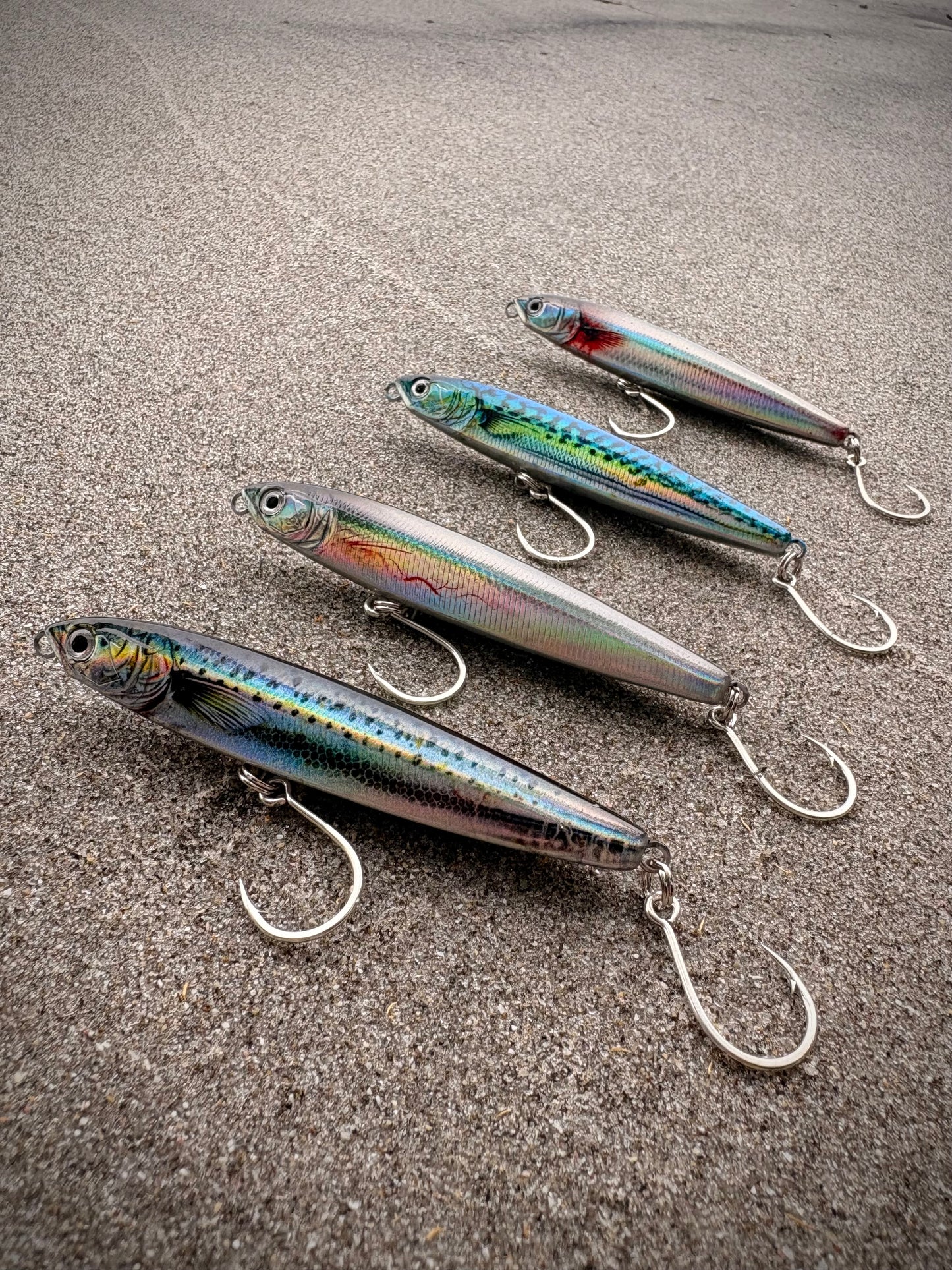
The SIVA is 95 mm, 25 g and sinking.
It's small enough to represent the sort of baitfish a flathead naturally eats.
It carries enough weight to cast a long way and reach the bottom quickly.
And because it's a sinking stick bait rather than a conventional floating hardbody, you control where in the water column it spends its time.
Let it sink.
Work it.
Pause it.
Allow it to drop back towards the bottom.
Bring it across sand.
Work it beside weed.
Cast along rather than simply across an edge.
You're trying to put a vulnerable little baitfish into the piece of water a flathead has selected precisely because vulnerable little baitfish eventually pass through it.
And because SIVA was designed around realistic baitfish profiles rather than fluorescent interpretations of them, colours such as Pilchard, Slimy Mackerel and Whitebait make a lot of sense in clear estuarine water.
Lifelike + Lethal.
Sometimes the marketing department gets an easy one.

AND THEN THERE'S THE “FRESHWATER FLATHEAD”...
Australia apparently decided one strange flattened ambush predator wasn't enough.
Meet the tupong.
Also called the congolli, freshwater flathead, marble fish and several other names, Pseudaphritis urvillii looks suspiciously like somebody took a flathead and released it into a river.
But here's the interesting part.
It isn't actually a true flathead.
Tupong belong to a different family.
They're endemic to southern Australia and Tasmania and inhabit estuaries, rivers and slow-flowing freshwater streams connected to the sea. Like flathead, they're beautifully camouflaged bottom-oriented ambush predators and may sit partially buried with only their eyes visible.
And their lifecycle is fascinating.
Adults can live in freshwater.
But when it's time to reproduce, mature fish migrate downstream during autumn and winter into estuarine areas.
Their larvae develop at sea.
Juveniles then return to river systems and gradually work upstream as they grow.
That's called catadromy — living much of your adult life in freshwater but migrating towards salt water to reproduce.
Large tupong are predominantly female, while males tend to remain smaller and are more common around estuarine and brackish habitat.
They even hunt in a familiar way.
Small fish.
Crustaceans.
Insects.
Molluscs.
Worms.
Wait.
Ambush.
Eat.
Evolution has a habit of arriving at similar solutions when animals face similar problems.
Apparently lying on the bottom looking like a stick until dinner comes too close is one of the better ones.
ONE LAST THOUGHT...
The dusky flathead isn't spectacular in the conventional sense.
It doesn't launch itself from the ocean.
It doesn't travel at 70 kilometres an hour.
It isn't covered in electric colour.
Most of the time, its greatest achievement is that you didn't notice it was there.
And that's exactly what makes it such an extraordinary predator.
Everything about the animal serves the same purpose.
The flattened body.
The upward-facing eyes.
The mottled camouflage.
The huge mouth.
The teeth.
The preference for edges, bottom and structure.
Even the way it uses an estuary.
It doesn't need to chase every baitfish it sees.
It only needs to put itself somewhere that eventually brings a baitfish to it.
So next time you're looking across an Australian estuary at an apparently empty patch of sand, don't just look at the water.
Look at the edges.
Look at the current.
Look at where the bait has to travel.
And look very closely at the bottom.
Because sometimes the most successful predator in the system is the one you can't see.
The flathead isn't built to chase its prey across the ocean.
It's built to make sure it never has to.
Know Your Target.
Because understanding your target doesn't stop with knowing where it lives.
You need to understand why it chose to be there.
LIFELIKE + LETHAL.