Southern Bluefin Tuna (Thunnus maccoyii)

Southern Bluefin Tuna do not hunt like reef predators.
They hunt like machines built to outrun failure.
If kingfish are executioners and cobia are inspectors, Southern Bluefin are endurance weapons. Everything about them — from blood chemistry to muscle temperature — is designed for one purpose:
Relentless pursuit.
To understand Southern Bluefin Tuna, you have to stop thinking about them as “big fish”.
They are warm-blooded missiles built for open ocean survival.
FORM AND FUNCTION — BUILT FOR DISTANCE
Southern Bluefin Tuna are among the most physically refined predators on earth.
Their shape is not simply streamlined.
It is hydrodynamic perfection.
The fusiform body reduces drag at speed. The narrow caudal peduncle channels immense force into the crescent-shaped tail. Small finlets behind the dorsal and anal fins reduce turbulence as water moves across the body at extreme velocity.
Nothing is accidental.
Everything reduces resistance.
Unlike many fish that rely on short bursts of white muscle, Bluefin Tuna are dominated by highly oxygenated red muscle capable of sustained power output over enormous distances.
This is why tuna don’t “sprint” in the way most people imagine.
They maintain pressure.
Hour after hour.
Kilometre after kilometre.
And they do it in conditions that would cripple lesser predators.
WARM-BLOODED HUNTERS
Southern Bluefin Tuna possess one of the ocean’s most extraordinary evolutionary advantages:
Regional endothermy.
In simple terms, they generate and retain body heat.
Using specialised vascular heat exchange systems called retia mirabilia, Bluefin can maintain muscle temperatures significantly above surrounding water temperature. Warm blood leaving the muscles transfers heat into colder blood returning from the gills, recycling energy rather than losing it.
This changes everything.
Warm muscles contract faster.
Warm nerves react quicker.
Warm eyes process movement more efficiently.
In cold southern oceans where baitfish slow down, Bluefin remain lethal.
They are not surviving those environments.
They are dominating them.
SPEED, PRESSURE, AND MOMENTUM
Large Southern Bluefin Tuna are capable of burst speeds exceeding 70 km/h.
But speed alone does not explain their power.
Momentum does.
A mature Bluefin is dense, muscular, and brutally efficient at maintaining kinetic energy through the water. Once moving, they do not waste effort constantly accelerating and decelerating like reef predators.
They conserve.
They glide.
Then they surge when opportunity appears.
This is why hooked tuna feel different to almost any other fish.
They don’t simply run.
They continue.
Line disappears not because of panic, but because the fish is operating exactly as designed: sustained power under load.
The ocean does not slow them down.
It amplifies them.

EYES, PRESSURE WAVES, AND THE HUNT
Southern Bluefin are visual hunters first.
Their large eyes are adapted for detecting contrast, movement, and vulnerability in open water where there is nowhere for prey to hide. In low-light conditions, depth changes, and turbulent water, they remain remarkably effective at isolating targets.
But vision is only part of the equation.
Like other pelagic predators, tuna also read vibration and pressure change through the lateral line system. Injured baitfish don’t just look wrong.
They move wrong.
A panicked saury skipping unevenly across the surface…
A mackerel falling below the school…
A baitfish slightly out of rhythm…
These tiny irregularities matter.
Because tuna are not random feeders.
They are energy investors.
Every strike is a calculation between effort and return.
And in a competitive feeding environment, hesitation means losing opportunity.
GROUP BEHAVIOUR — CONTROLLED CHAOS
Southern Bluefin Tuna rarely hunt alone.
Juveniles may school in massive numbers, but even mature fish often operate in coordinated groups loosely connected through movement and visual awareness.
This creates one of the ocean’s most violent spectacles:
The workup.
Baitfish are compressed upward from below while seabirds attack from above. Water erupts. Foam builds. The surface becomes chaos.
But beneath that chaos is structure.
Tuna are constantly adjusting spacing, angle, and pressure to prevent bait escaping the kill zone. Individuals react instantly to directional changes from nearby fish, creating coordinated feeding behaviour without obvious communication.
To anglers, it looks random.
To tuna, it is organised pressure.
And once feeding momentum starts, aggression escalates rapidly.
One fish committing often triggers dozens more.
DIET AND HUNTING STRATEGY
Southern Bluefin Tuna are opportunistic apex predators.
Their diet includes:
- Pilchards
- Mackerel
- Saury
- Squid
- Flying fish
- Small tuna species
- Juvenile reef and pelagic fish
But regardless of prey type, one principle remains constant:
They isolate weakness.
Tuna target:
- Stragglers
- Injured bait
- Disoriented fish
- Anything separated from the school
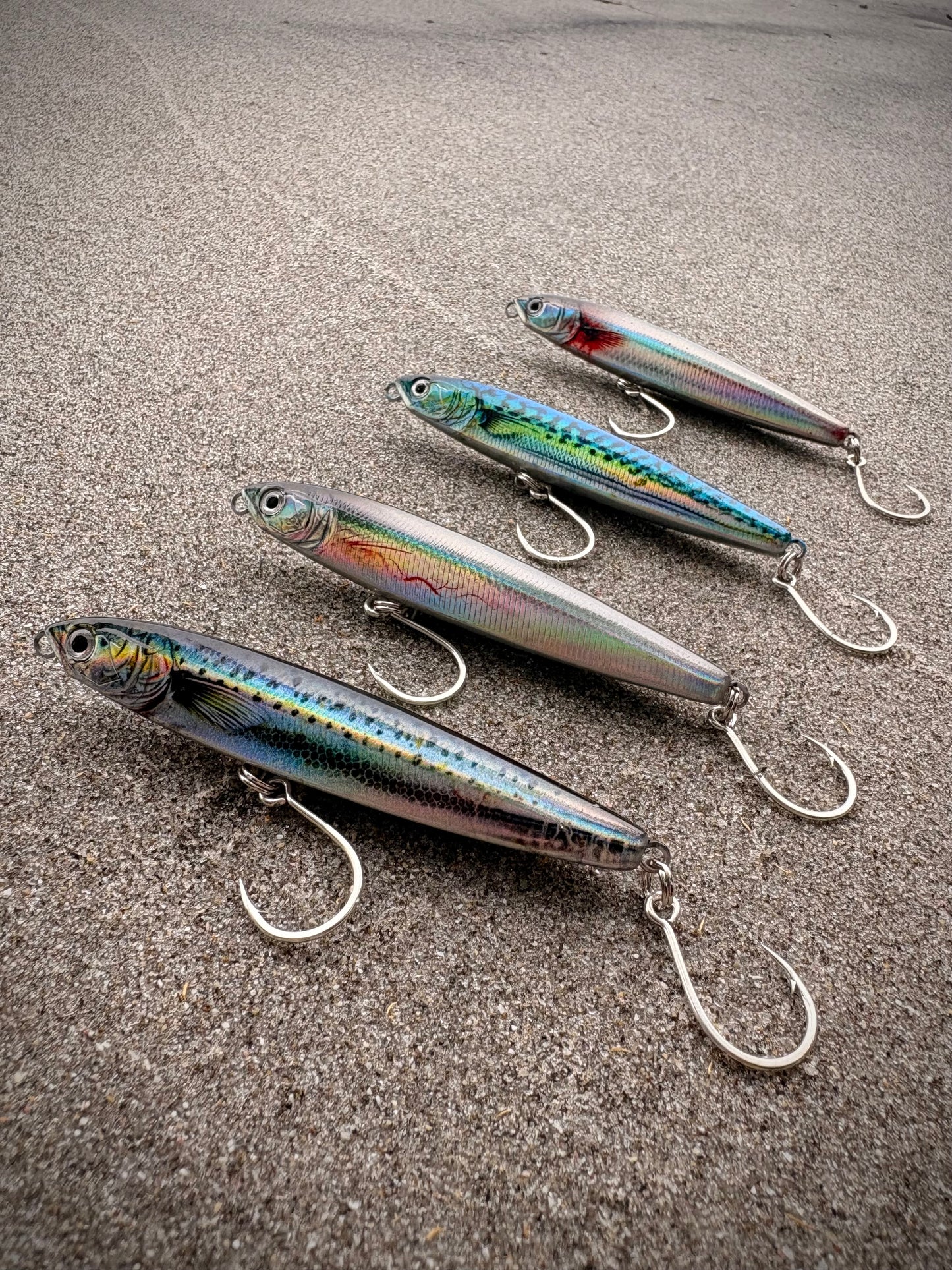
This is why realistic lure presentation matters so much.
Not flash.
Not noise.
Vulnerability.
A lure that tracks perfectly straight at constant speed can look unnatural in a pressured feeding environment. Slight instability, directional change, or an irregular skip can trigger instinct far more effectively than exaggerated action.
Because tuna are not trying to catch the strongest baitfish.
They are trying to catch the one most likely to fail.

THE SURFACE FEED — VIOLENCE WITH PURPOSE
Few moments in fishing rival a Southern Bluefin surface feed.
Whitewater erupts.
Birds dive.
Bait scatters in every direction.
But despite the spectacle, Bluefin are remarkably selective inside the chaos.
They are not blindly smashing anything that moves.
They are locking onto individual targets within collapsing bait schools.
This explains why anglers can cast repeatedly into feeding tuna and still fail to hook up.
The lure may be visible.
But it does not look vulnerable enough.
When tuna commit, they do so with terrifying efficiency. The strike is often instantaneous because the decision was made long before the lure disappeared beneath the surface.
GROWTH, SIZE, AND LONGEVITY
Southern Bluefin Tuna are among the largest and longest-lived pelagic predators in the southern hemisphere.
Fish exceeding 2 metres and 150 kilograms are well documented, with exceptional specimens pushing far beyond that. Ageing studies suggest individuals may live for decades under favourable conditions.
But size comes at a cost.
Southern Bluefin are slow-growing relative to many pelagic species and take years to reach full reproductive maturity. This makes populations vulnerable to overfishing pressure, particularly during juvenile stages.
Large Bluefin represent survival against immense odds.
Distance.
Predation.
Commercial pressure.
Environmental change.
They are not common by accident.
INTELLIGENCE AND ADAPTABILITY
Southern Bluefin Tuna are constantly adjusting to temperature, bait movement, current flow, and pressure systems.
They migrate enormous distances across the southern ocean following food availability and optimal conditions. Entire feeding patterns may shift with water temperature changes of only a few degrees.
Some days they feed recklessly on top.
Other days they hold deep and become frustratingly selective.
Understanding Bluefin means understanding conditions, not just fish.
Because these predators are not tied to structure.
They are tied to efficiency.
Where the equation works, they appear.
RESPECT THE TARGET
Southern Bluefin Tuna are not simply powerful fish.
They are biological engines built for endless motion.
Every heartbeat, every muscle fibre, every evolutionary adaptation serves one purpose:
Pursuit without fatigue.
When a Bluefin erupts beneath a bait school, you are not witnessing chaos.
You are witnessing one of the most advanced predators on earth operating exactly as intended.
To know Southern Bluefin Tuna is to understand pressure, momentum, and vulnerability.
They do not stop because the ocean is cold.
They do not stop because the bait is fast.
They do not stop because the distance is immense.
They continue because they were built to.
Know your target.
Respect your target.
OOSH.