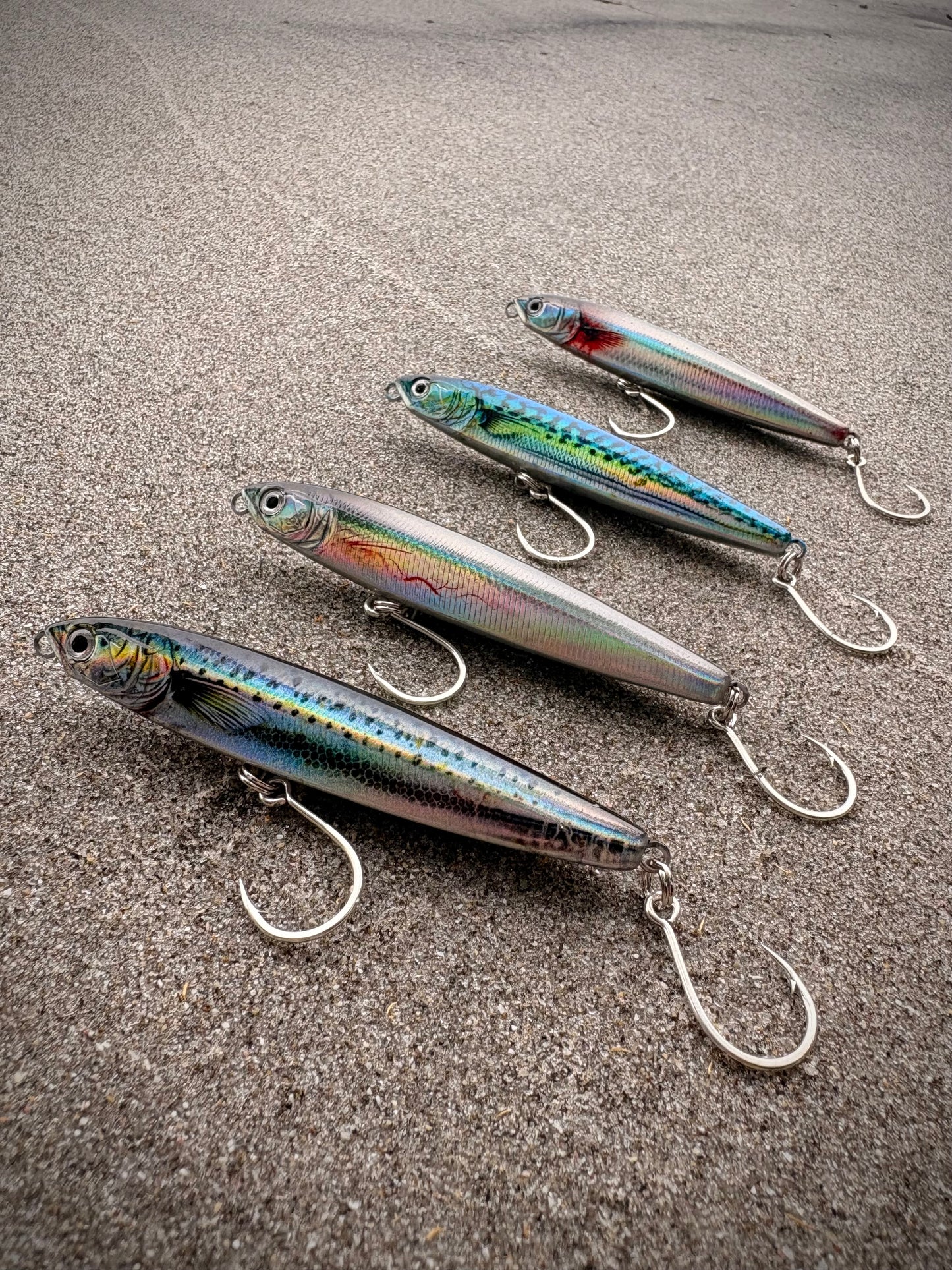
KNOW YOUR TARGET: DO FISH SEE COLOUR?

It's one of the oldest debates in fishing.
Some anglers swear lure colour is everything. Others insist colour doesn't matter at all, arguing that action, depth and presentation are far more important.
The truth lies somewhere in between.
Fish are not colour blind. Many species can see colour remarkably well. Some may even detect wavelengths of light beyond human vision. But understanding how fish see is far more complex than simply asking whether they can distinguish blue from green or red from silver.
The real question is:
What information are predators actually using when they decide to attack?
To answer that, we need to understand how fish see the world around them.
A DIFFERENT WORLD TO OURS
Human vision evolved in air.
Fish vision evolved underwater.
That difference matters.
Water absorbs and scatters light. Colours change with depth. Visibility varies from crystal-clear ocean water to murky harbours and estuaries. Predators must interpret a constantly changing environment while locating prey that may only be visible for a split second.
As a result, fish eyes evolved differently from our own.
Like humans, most fish possess two primary types of photoreceptor cells:
Rod Cells
Rod cells are specialised for:
- Detecting movement
- Low-light vision
- Dawn and dusk feeding
- Night-time hunting
- Identifying contrast
Rod cells are extremely sensitive to light but do not detect colour.
Think of them as a fish's night vision system.
Cone Cells
Cone cells are responsible for:
- Colour perception
- Detail recognition
- Daylight hunting
- Identifying prey characteristics
The number and type of cone cells varies dramatically between species.
Some predators possess visual systems capable of detecting subtle differences in colour and contrast that help them locate prey more efficiently.
Others rely more heavily on movement, vibration and silhouette.

NOT ALL PREDATORS SEE THE SAME WAY
Different species evolved for different hunting styles.
A snapper feeding around reefs and structure sees the world differently from a bluefin tuna hunting at speed in open water.
Understanding these differences helps explain why certain lure colours, finishes and presentations can perform differently depending on the target species.
HOW KINGFISH SEE THE WORLD
Yellowtail Kingfish
Kingfish are highly visual predators.
Everything about their behaviour suggests a species that relies heavily on eyesight.
They hunt fast-moving baitfish including:
- Koheru
- Jack mackerel
- Pilchards
- Kahawai
- Flying fish
Kingfish often patrol beneath bait schools, scanning for weakness, separation and opportunity.
Unlike ambush predators, kingfish frequently make decisions while moving at speed.
This requires excellent visual processing.
Research on kingfish and closely related jack species indicates strong colour vision and the ability to detect subtle visual differences between potential prey items.
However, colour is only part of the equation.
Kingfish are exceptionally sensitive to:
- Flash
- Contrast
- Direction changes
- Erratic movement
- Isolated targets
A kingfish may notice colour, but it is often visual irregularity that triggers the attack.

HOW SNAPPER SEE THE WORLD
Australasian Snapper
Snapper live in a very different environment.
Much of their feeding occurs around:
- Reefs
- Structure
- Weed beds
- Broken ground
- Deeper water
Visibility is often reduced compared to open-water pelagic environments.
Because of this, snapper appear to rely heavily on:
- Contrast
- Silhouette
- Movement
- Flash
- Scent
Snapper certainly possess colour vision, but colour alone rarely explains their feeding behaviour.
Many anglers have caught snapper on lures in colours that bear little resemblance to any natural prey species.
Why?
Because snapper are often responding to visibility rather than realism.
A bright lure may simply be easier to locate.
A dark silhouette may stand out more effectively against the surface.
For snapper, being noticed is often more important than being perfect.

HOW BLUEFIN TUNA SEE THE WORLD
Southern Bluefin Tuna
Few predators possess vision as impressive as a tuna.
Bluefin tuna are built for speed, endurance and precision.
They often hunt within enormous bait schools containing thousands of fish.
Yet somehow they can identify and target individual prey items.
To achieve this, tuna possess:
- Large eyes
- Excellent long-range vision
- Exceptional motion detection
- High-speed visual processing
Their eyes are specifically adapted for tracking prey while moving at significant speed.
This helps explain why bluefin can become extremely selective during feeding events.
When bait is abundant, they have the luxury of choice.
They can afford to inspect potential prey more carefully than many anglers realise.
This is one reason subtle details can matter when targeting large tuna.

HOW SPANISH MACKEREL SEE THE WORLD
Spanish Mackerel
Spanish mackerel are among the fastest visual predators in coastal waters.
Unlike reef species that investigate prey, Spanish mackerel are often making split-second decisions.
Their hunting style relies heavily on:
- Speed
- Ambush
- Rapid acceleration
- Visual target acquisition
Spanish mackerel frequently attack from below or behind a bait school, using bursts of speed to slash through prey.
To do this effectively they require:
- Excellent contrast detection
- Strong motion tracking
- Rapid visual processing
This helps explain why flash-based presentations are often so effective.
A brief flash from a turning baitfish can immediately draw attention.
To a Spanish mackerel, a flash may represent a fleeing prey item, a panicked baitfish or a momentary opportunity.
The strike often happens before the baitfish even realises it is being hunted.

FISH DON'T JUST SEE COLOUR — THEY SEE OPPORTUNITY
This is where lure design becomes truly interesting.
Predators are not swimming around analysing paint charts.
They are searching for clues.
Clues that identify an easy meal.
A predator's goal is not to catch the strongest fish.
It is to catch the easiest fish.
The prey that requires the least energy.
The prey most likely to be caught.
The prey least likely to escape.
This means predators often focus on signs of vulnerability.
 WOUNDS, WEAKNESS AND VULNERABILITY
Across countless species, predators repeatedly target prey that appears compromised.
This may include:
- Injuries
- Disease
- Fatigue
- Separation from the school
- Reduced reactions
- Irregular swimming behaviour
A wound tells a story.
It may indicate:
- A recent attack
- Physical weakness
- Reduced swimming performance
- A fish already struggling to survive
To a predator, this represents opportunity.
Visual abnormalities can become powerful triggers because they help predators identify targets that are easier to catch.
This may explain why predators often show interest in prey displaying unusual markings, damage or signs of distress.
In nature, perfection is not always what gets eaten.
Difference often does.
FLASH: THE LANGUAGE OF BAITFISH
One of the most important visual triggers in the ocean is flash.
Baitfish produce flashes constantly.
Every time a baitfish turns, rolls or changes direction, its scales reflect light differently.
To predators, these flashes communicate information.
They reveal:
- Location
- Direction
- Speed
- School movement
- Panic
A fleeing baitfish school can create thousands of flashes in seconds.
Predators learn to interpret these visual signals.
A sudden flash often indicates:
"Something just changed."
That change may represent an opportunity.
This is why reflective finishes remain effective across countless lure styles and species.
Flash attracts attention long before colour becomes important.

THE HIDDEN WORLD OF ULTRAVIOLET LIGHT
Humans cannot see ultraviolet light.
Many fish can.
Research has shown that numerous fish species possess receptors capable of detecting UV wavelengths.
Many baitfish also naturally reflect UV light.
This creates an entirely separate layer of visual information that exists beyond human perception.
To an angler:
Two lures may appear identical.
To a predator:
One may stand out dramatically.
Scientists are still learning exactly how different species use UV information.
However, evidence suggests UV may assist with:
- Detecting prey
- Increasing contrast
- Identifying baitfish
- Improving visibility under certain conditions
The underwater world contains visual information that humans never see.
Predators may be making decisions based on signals completely invisible to us.

WATER CHANGES EVERYTHING
Even the best eyes can only work with available light.
As sunlight travels through water, colours gradually disappear.
Not all colours penetrate equally.
Generally speaking:
- Red disappears first.
- Orange fades next.
- Yellow weakens with depth.
- Green penetrates further.
- Blue travels furthest.
This means a lure can appear completely different at 10 metres than it does in your hand.
A bright red feature may eventually appear dark grey or black.
A silver flash may become more important than body colour.
A silhouette may become more visible than fine detail.
The deeper the water, the more important contrast often becomes.
This is why colour discussions cannot be separated from water conditions.
The fish only sees what the available light allows it to see.
SO DOES COLOUR MATTER?
Yes.
But probably not in the way most anglers think.
Predators do not make decisions based solely on colour.
Instead, they process multiple visual cues simultaneously.
These may include:
- Movement
- Flash
- Contrast
- Silhouette
- Vulnerability
- Colour
- UV reflection
Colour is one piece of a much larger puzzle.
A lure with perfect colour but poor presentation may fail.
A lure with excellent presentation but reasonable colour often succeeds.
The most effective presentations combine multiple triggers into a single convincing package.

THE TAKEAWAY
Predators do not see the ocean the way we do.
Kingfish scan for weakness within a school.
Snapper search for contrast around structure.
Bluefin tuna analyse prey while travelling at extraordinary speeds.
Spanish mackerel react instantly to flashes of opportunity.
Each species processes visual information differently.
Yet they all share one thing in common.
They are constantly searching for clues that identify prey worth attacking.
Colour matters.
But it is rarely the entire story.
Understanding what predators actually see is one of the most powerful ways anglers can better understand what makes fish strike.
A predator may notice the colour of a baitfish—but it is often the flash, contrast, movement and signs of vulnerability that convince it to attack.
OOSH
LIFELIKE + LETHAL